
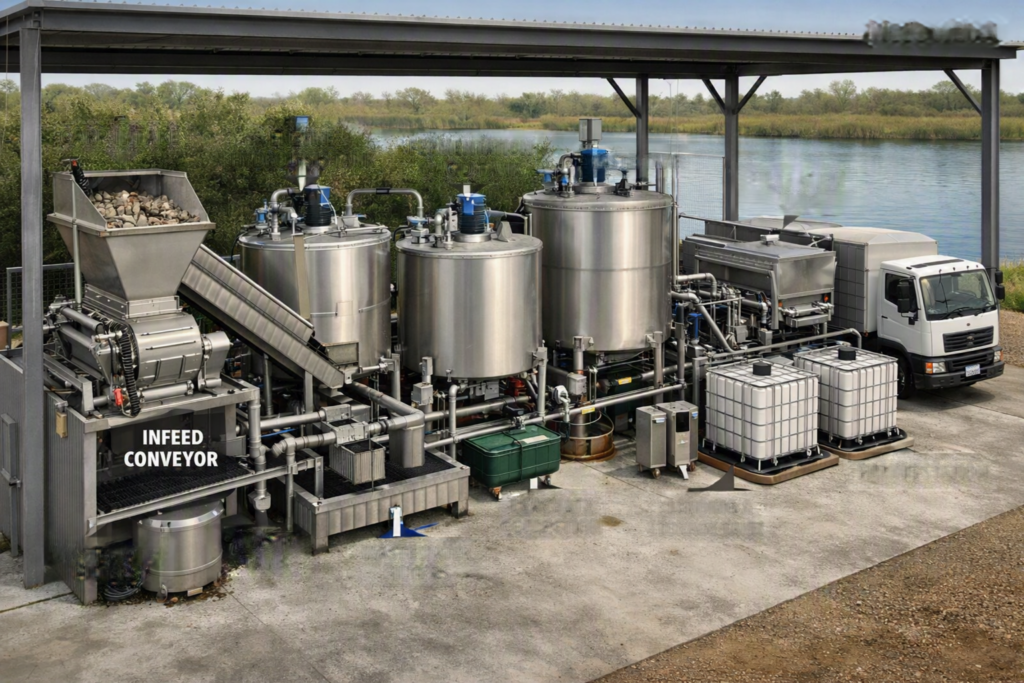
Description
Why Fish Hydrolysate?
Unlike traditional fish composting, fish hydrolysate production delivers a more controlled, nutrient-rich, and marketable product. The resulting liquid fertiliser is easier to transport, store, apply, and standardise, providing growers with a reliable biological soil amendment that supports plant health, soil biology, and crop performance.
How the System Works
1. Regional Collection & Logistics Network
A centralised collection model streamlines operations and reduces processing costs.
- Partner with carp harvesting programs, fishing competitions, and commercial operators
- Establish bulk collection bins and IBC drop-off points at boat ramps and collection hubs
- Implement scheduled transport routes to move harvested carp to processing facilities efficiently
2. Advanced Fish Processing
Whole carp are converted into a safe, manageable feedstock.
- Industrial grinding and maceration systems produce a uniform slurry
- Integrated screening removes hooks, debris, and contaminants
- Sealed processing tanks control odour and maintain biosecurity standards
3. Fish Hydrolysate Production
The core value-creation stage.
- Fish slurry is stabilised through controlled acidification or fermentation
- Anaerobic sealed tanks minimise odour and maximise nutrient preservation
- Proteins are naturally broken down into plant-available compounds
- Continuous monitoring of pH and temperature ensures product stability and safety
4. Product Refinement & Quality Assurance
A consistent fertiliser product is created for commercial sale.
- Filtration removes remaining solids
- Optional oil and fat separation increases product uniformity
- Laboratory testing verifies nutrient values and quality standards
- Product formulations can be enhanced with humates, molasses, minerals, or other biological additives
5. Commercial Packaging & Distribution
Ready for farms of every size.
- Available in 200 L drums, 1,000 L IBCs, or bulk tanker supply
- Clear nutrient analysis and application instructions
- Forklift and transport-friendly packaging systems
- Scalable for regional, national, and export markets
6. On-Farm Application Programs
Building long-term agricultural demand.
- Crop-specific application protocols
- Fertigation, soil drench, and foliar application guidelines
- Training and support for storage and handling
- Soil health and crop performance monitoring
- Regulatory compliance and environmental best-practice frameworks
Key Benefits
 Converts invasive carp into a valuable commercial product
Supports river restoration and environmental management programs
Creates new regional jobs and processing industries
Produces a high-demand biological fertiliser
Reduces waste and promotes circular economy outcomes
Generates measurable sustainability and ESG benefits
Scalable from regional pilot projects to national deployment
Reviews
There are no reviews yet.